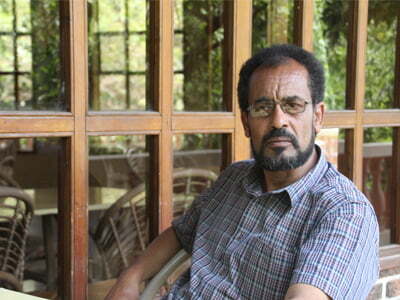
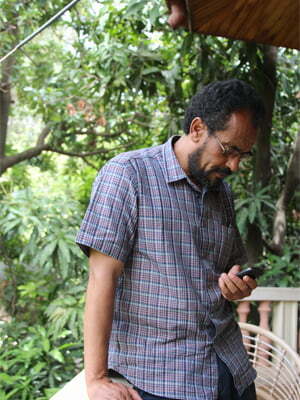
Born in 1961 in West Wollega region of western Ethiopia, Bekele Gerba went to elementary school in Boji Dirmaji and completed his high school in Gimbi senior secondary school. Bekele was graduated with BA degree in foreign language and literature from the Addis Abeba University (AAU) and taught in Dembi Dolo and Nejo high schools in western Ethiopia, among others. He finished his post graduate studies in 2001 in teaching English as a foreign language at the AAU and went to Adama Teachers’ College, 98kms south of Addis Abeba, where he taught English and Afaan Oromo. Suspected of allegedly supporting students’ riot that took place a year before, Bekele was dismissed in 2005 by the college. He then came to Addis Abeba where he taught in two private universities for two years until he was employed in 2007 as a full time lecturer by the AUU where he continued teaching English. Bekele’s political career began in 2009 when he joined the opposition party, Oromo Federalist Democratic Movement (OFDM), as a member of the executive committee and head of the public relations department. Bekele participated and lost in the 2010 parliamentary elections in which the ruling EPRDF claimed more than 99% of the seats in parliament. A father of four, Bekele was arrested in 2011 and sentenced to eight years in prison suspected of allegedly belonging to the banned Oromo Liberation Front (OLF). Upon appeal to the Supreme Court, his sentencing was reduced to three years and seven months with a right to parole. After the merger in 2012 of OFDM and Oromo Peoples’ Congress (OPC) that became known as the Oromo Federalist Congress (OFC) Bekele was appointed as First Deputy Chairman while he was still serving his sentence. Although he was paroled and was eligible to be free in 2014 Bekele was released in the first week of April 2015 only after he finished his sentencing. A few days after his release Bekele agreed to sit down for his first extensive interview with our Editor-in-Chief Tsedale Lemma. Excerpts:
Addis Standard – I would like to congratulate you for being a free man at last. But what was it like to be in prison?
Bekele Gerba - Prison is not a place one appreciates to be. But I think it is also the other way of life as an Ethiopian; unfortunately it has become the fate of many of our people. You will find a lot of students, youngsters, brothers and sisters, sons and fathers, husbands and wives. Especially when it comes to the Oromo, they are there in great numbers. Therefore going there or being there was a very good experience by itself because you will understand the agony and the hardship our people are facing at the moment. There are lots of problems there too, from the type of food people eat to the type of bed they sleep on. But there are a lot of things to learn from them so I think for me it has been a place of training.
What was your everyday life like and what was your biggest challenge?
My biggest challenge was the first one year and two months when I was kept in maximum security in Kality prison. The room was very small and the type of people we were with are regarded as deadly criminals in this country; they fight and even the police are scared of them. Sometimes they use drugs and they fight easily with anybody. It is a very difficult place. After being there for a year and two months I was sent to Ziway. Ziway is a place where people who come from the countryside are always kept; people who are economically not well off, mainly people who are allegedly suspected of having links with the Oromo Liberation Front (OLF). And most of them are Oromos there.
There is this popular term that says ‘the prisons in Ethiopia speak Afaan Oromo.’ Is it what you are confirming to me now?
Exactly. If you take away the large number of thieves (the most popular crime there [in Ziway] is theft – and say may be out of 5000 or 6000 prisoners there about 3000 or 4000 thieves) and if you take away those people who are suspected of corruption, very few in number in fact, the rest you can say they are all Afaan Oromo speakers.
How did that make you feel as a politician whose party represents the Oromo and as an Oromo?
In one way I am very glad to be there because I felt myself sharing the agony of my own people. How am I different from those people? Those people went to prison because they demanded their rights; I was also there because I demanded my rights. In this country I thought that the Oromos are being excluded from the political and from the economic spheres or participation, something I always object. Therefore I am very glad to be there. I remember the first day I went to the court before my arrest just to see how the court was proceeding when about 500 or 600 Oromos were imprisoned and then taken to the court. I went there as a party member to witness and to see what was going on around. I felt very badly because I saw the prosecutors organizing false evidences; they were calling upon people and they were giving them orientations to testify against people whom they didn’t know at all, whom they have never seen before. I was sad and I called some media that day and gave a brief interview. I think it was after the airing of that interview that the government started following me in order to stop what I was doing. But since I was the spokesman of my party that was the job given to me – to give press conferences or sometimes press releases of what was going on around the party and anything related to the Oromo people. But after I went to prison I was relieved because I had to experience the agony of my people; I had to share their pain and I am glad for that.
Going by your own explanation, if living the pain and agony of your fellow countrymen brought you relief, how did that affect your other life that you stood for? You had a family, you had a political life, and you had a career that you had to leave behind.
Like anybody else, like a human being, when you miss your family of course you feel sad. But my family is no different from other peoples’ family. For example there is a family that I know, the husband was in prison and when he was released the wife was taken to prison. Their children are growing up without a father at one time and a mother at another; my children are no better than these. And if only my family, if only a group of people enjoy normal life and the great majority are not doing the same, I think your happiness or your joy cannot be complete. Of course when I first went there I thought my family would be affected very badly but they are very courageous and they were very supportive psychologically. They were very strong and thanks to many Oromos my children did not quit school and my family has not suffered as such economically.
Your daughter Bontu gave an interview to Afuraa Biyyaa radio station once and told the station you were suffering from ill health. Walk me through that. What happened? How did you maintain your health afterwards?
During the first two three days soon after I was taken to Ma’ekelawi [prison] I started having severe headache and the nurses told me that my blood pressure was high. I had never had that experience before. I was then taken to the Police Hospital and was diagnosed with the same thing; the nurses told me that I looked like a chronic hypertensive patient. I have not had that kind of medical history. Since then until I came out of the prison a few days ago, my blood pressure has been on the rise; I think may be because of the tension, I don’t know. But I am happy that after I was released I am quite okay. I haven’t taken any medication or I have not consulted any physician since my release; I feel I am healthy.
What did help you maintain your everyday sanity when you were there? Was it your interaction with other inmates? Did you have access to books?
The first year was a very difficult time and we have not had enough books and we didn’t know how to smuggle books or any magazines or anything to be read. We have not had any relations with the police; that was a very difficult time until we adjusted ourselves to the prison situations. But later on we started having some books to read that some friends brought for us. We started reading and on a small scale started writing, although it was very difficult to get it out because every three weeks or so the prison police would conduct a search and take away anything that is written; that was the difficult part of it. But after I went to the prison in Ziway I had a chance to meet senior people from the army and from the air force who were accused of staging a coup. Those are people like General Tefera and General Asamenew who were taken to Ziway together. We stayed together and they are very understanding people; they like reading, they like discussions and I enjoyed the discussions. We shared books; we read whatever books we could lay our hands on. That helped me to squeeze through all these bad times.
Moving out of your time in prison, can you tell me what it was like growing up as Bekele Gerba, an Oromo child?
Surprisingly the place I was born and raised is a typical monolingual area. All the people around, all the shop owners or